
THE PROTECTION OF PERSONAL INFORMATION ACT (POPIA) CLIENT/ USER PRIVACY PROTOCOLS POLICY
INTRODUCTION
Preamble
The purpose of this policy is to advise the client/ user (data subject) of Inscape Property Management (Pty) Ltd (IPM) services, both electronic and otherwise, why data is collected and processed, what data is in focus as well as how it is processed. IPM is committed to full compliance with the POPI Act insofar as the utilisation and disclosure of data subject personal information (PI) is concerned. Hence, technical and operational measures have been put in place to protect data subject privacy and IPM invites all data subjects and/ or requesters to engage with its Information Officer (IO) in respect of any matter related hereto.
Scope of application
This policy applies to data subjects under the POPI Act and its principles extend to the Promotion of Access to Information Act (PAIA) in respect of requesters of records held by IPM. PI applies to both natural and juristic persons. Data subjects and requesters are invited to engage with the IPM IO about any matter pertaining to the POPIA and PAIA, including but not limited to updating PI, deletion of PI, complaints in respect of how PI is being processed and updating consent for electronic direct marketing. The “Information Officer” portal on the website facilitates these types of engagement.
About IPM
IPM is the property administrators for the various companies in the Inscape Group. Our Portfolio comprises of Commercial, Retail, and Industrial property in the various provinces. Our head office is based in East London. More details in this regard can be obtained in the “About IPM” link to its website.
Definition of Personal Information (PI)
‘‘Personal information’’ means information relating to an identifiable, living, natural person, and where it is applicable, an identifiable, existing juristic person, including, but not limited to—
(a) information relating to the race, gender, sex, pregnancy, marital status, national, ethnic or social origin, colour, sexual orientation, age, physical or mental health, well-being, disability, religion, conscience, belief, culture, language and birth of the person;
(b) information relating to the education or the medical, financial, criminal or employment history of the person;
(c) any identifying number, symbol, e-mail address, physical address, telephone number, location information, online identifier or other particular assignment to the person;
(d) the biometric information of the person; (e) the personal opinions, views or preferences of the person;
(f) correspondence sent by the person that is implicitly or explicitly of a private or confidential nature or further correspondence that would reveal the contents of the original correspondence;
(g) the views or opinions of another individual about the person; and
(h) the name of the person if it appears with other personal information relating to the person or if the disclosure of the name itself would reveal information about the person;
Purpose of Collecting and Processing PI
IPM processes PI for various purposes including for –
• Facilitating transactions with data subjects
• Leases and contractual agreements
• Fulfilling its contractual obligations to its clients and client contacts
• Complying with the provisions of statute and regulations
• Attending to the legitimate interests of data subjects
• Identifying prospects for enhanced service delivery and business sustainability
• Tracking data subject activity on the website and its links as well as their transactions with IPM
• Confirm and verify data subject identity or to verify that they are authorised users for security purposes;
• Audit and record keeping purposes
• In connection with legal proceedings.
Lawful Basis
In respect of the processing of PI as provided for above, IPM will adhere to the conditions for the lawful processing of PI, based on its desire to provide data subjects services in their best interests as well as a legitimate interest of IPM to achieve its business objectives.
Period of holding Personal Information
IPM endeavors to provide the most accurate information possible to stakeholders, including data subjects. IPM seeks to verify the accuracy of its information as frequently as possible and to remove information that it learns to be inaccurate. Thus, IPM intends to process the information it has about data subjects for so long as it is accurate or until the data subject instructs IPM to refrain from processing it – in order to instruct IPM to refrain from collecting and/ or processing PI click here to access the Information Officer portal.
Notwithstanding the above, IPM shall hold PI for such period as may be required in terms of statutes such as the Companies Act and various labour laws.
Data Subject Rights
Data subjects have the right to request that IPM provide them with access to their PI, to rectify or correct their personal information, erase PI or restrict the processing of PI, including refraining from sharing it or otherwise providing it to any third parties. Data subjects also have the right to raise complaints with the Information Regulator. The afore-going rights may be subject to certain limitations pursuant to applicable law. In order to access any of these rights, access the Information Officer portal.
Sources of Personal Information (PI)
IPM gathers PI from several sources, which include directly from data subjects, publicly available sources such as websites, commercial transactions with IPM, referrals, prospects, partner agreements, and the like. Given that PI can be extracted and/ or obtained from several sources and consolidated into one CRM or other similar systems of record, it may be difficult or impossible to identify the exact source of one particular piece of information.
Categories of Personal Information (PI) collected and processed
IPM collects information about data subjects who may be clients, client contacts, prospective clients and prospective client contacts. It also collects information on its employees and suppliers as well as third parties that are part of its scope of operation.
In respect of clients, client contacts, prospective clients and prospective client contacts IPM profiles business organizations and the contacts who work for the said organisations and it may have some or all of the following categories of personal information on data subjects, historical or current –
• Name and surname
• Identity Number
• Equity, Gender & Disability status
• Contact details (email, mobile)
• Birth date
• Position held and responsibilities
• Record of services used
• Email correspondence and attachments
• Organisation details
• Office address
• Office contact details
• Organisation email Address
• Organisation and data subject Social media URL’s
• Other information that is available in the public domain.
We collect and process your personal information mainly to contact data subjects for the purpose of understanding their requirements and delivering services accordingly. Where possible, we will inform data subjects what information they are required to provide to IPM and what information is optional, as well as the consequences of not providing the said information.
Website usage information may be collected using “cookies” which allows IPM to collect standard internet visitor usage information.
Disclosure of information
IPM may disclose data subject PI to its service providers who are involved in the delivery of products or services data subjects. IPM has agreements in place to ensure that it complies with the privacy requirements as required by the POPI Act.
IPM may also disclose data subject PI:
• Where it has a duty or a right to disclose in terms of law and/ or industry codes;
• Where it believes it is necessary to protect its rights.
Information Security
IPM is legally obliged to provide adequate systems, technical and operational protection for the PI that it holds and to prevent unauthorized access to as well as prohibited use of PI. IPM will therefore on a regular basis review its security controls and related processes to ensure that the PI of data subjects remains secure.
IPM has conducted an impact assessment across all of its functions and used the findings thereof to manage risk optimally as well as to provide iterative improvements on an ongoing basis. IPM policies and procedures cover the following aspects –
• Physical security;
• Computer and network security;
• Access to personal information;
• Secure communications;
• Security in contracting out activities or functions;
• Retention and disposal of information;
• Acceptable usage of personal information;
• Governance and regulatory issues;
• Monitoring access and usage of private information;
• Investigating and reacting to security incidents.
IPM also ensures that it contracts with Operators as required by POPI and it requires appropriate security, privacy and confidentiality obligations of these operators in order to ensure that personal information is kept secure. The same protocols apply to any party to whom IPM may pass PI on to for the purposes mentioned herein.
HOW TO CONTACT US
Head Office and Information Officer:
Our Head Office physical address is:
2nd Floor, Global House, 3 Pearce Street, Berea, 5241, South Africa
The information officer is:
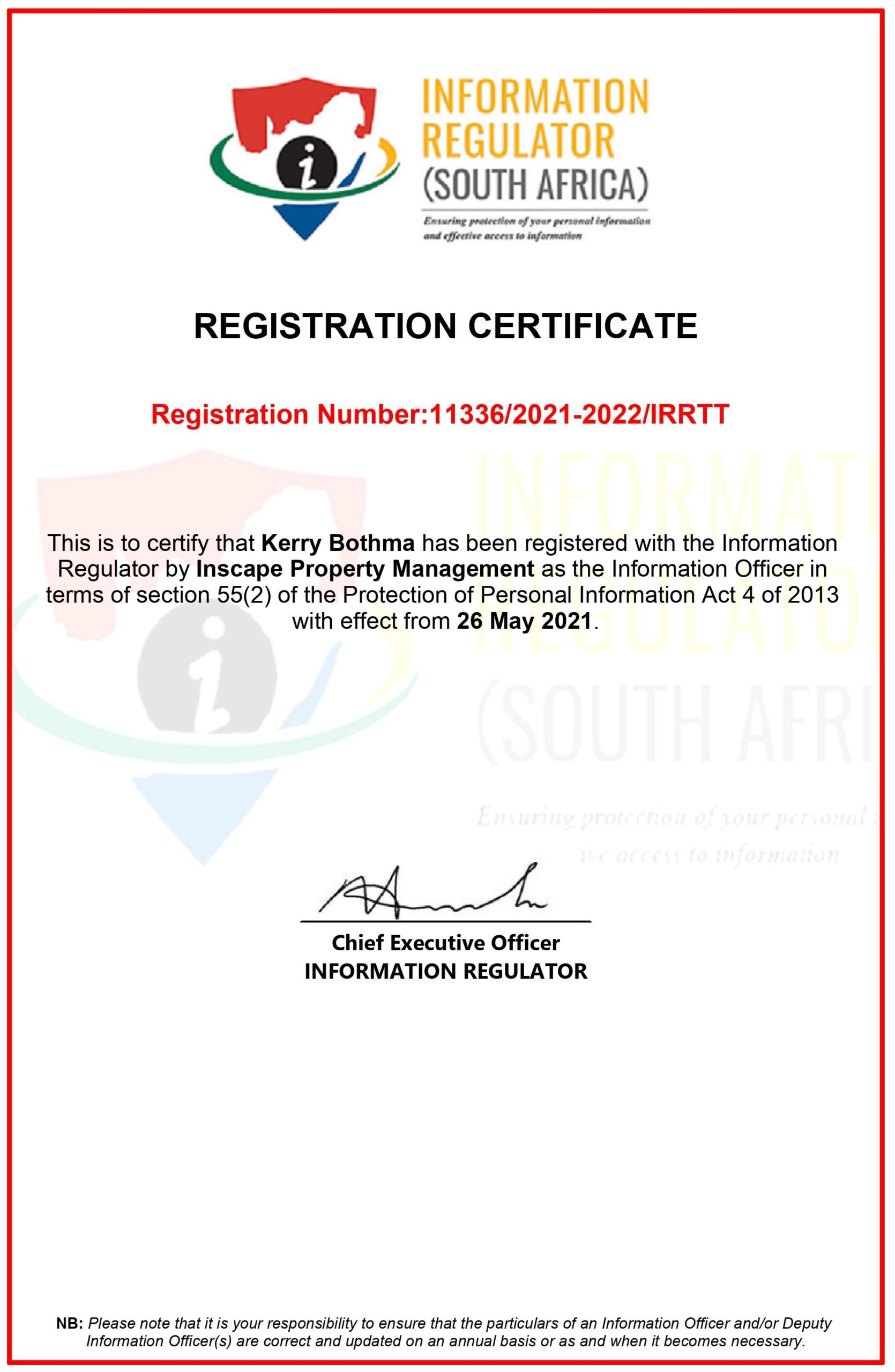
Kerry Bothma
Email: kerry@globalbusiness.co.za
Mobile: 083 482 4329
Or click here to go to the Information Officer portal to access specific engagement options.
Our Portfolio includes properties in the Commercial, Retail and Industrial sectors, tenanted mainly by national tenants.